



Medically reviewed by: Dr. Divya J G, MBBS, MS (OBG), DNB, FMAS, FRM, Consultant Obstetrician and Gynaecologist Last reviewed: 25 October 2026
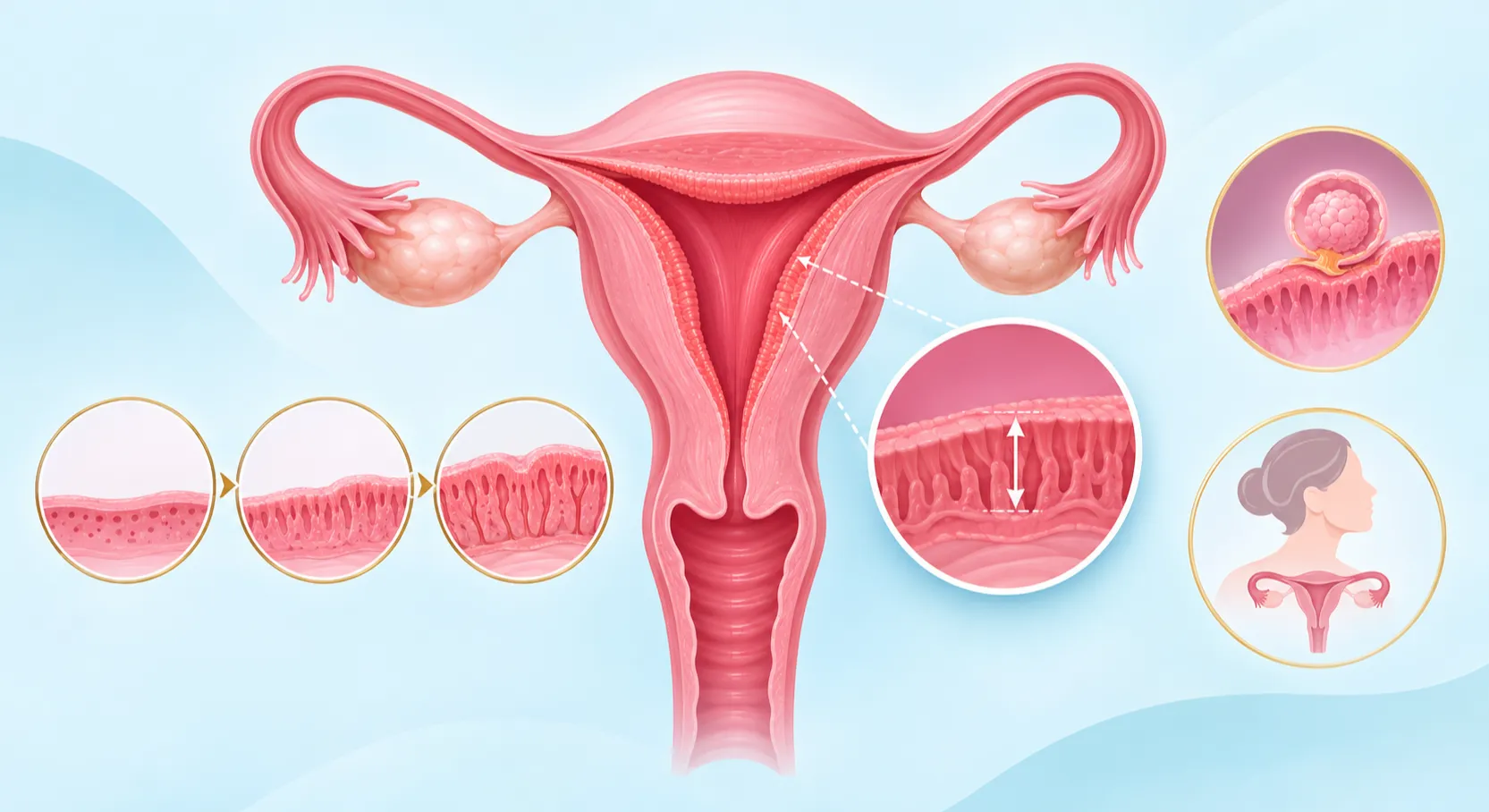
The endometrium is the inner lining of the uterus. Each month it thickens to prepare for a possible pregnancy, and if there is no pregnancy it sheds as your period. Doctors measure it on an ultrasound scan and report it in millimetres. Endometrium thickness depends on the day of your cycle, your age and your hormones, so there is no single normal number.
Normal endometrial thickness at a glance: about 2 to 4 mm during the period, 5 to 7 mm in the week after it, 8 to 12 mm around ovulation and up to 16 mm, sometimes 18 mm, in the second half of the cycle. For pregnancy, around 7 to 8 mm or more is generally considered favourable, but thickness alone does not decide the outcome. After menopause, 4 mm or less is reassuring when there is bleeding.
What Is the Endometrium and How Is It Measured?
The endometrium is measured on a transvaginal ultrasound, which gives the clearest view. The doctor looks at the uterus in a side-on (sagittal) view and measures both layers of the lining together, from one edge to the other. This measurement is called the endometrial echo complex. Because it changes through the month, the same woman will have different values on different days. Reports from different centres can also differ by a millimetre or two, depending on the machine and the person measuring.
Normal Endometrial Thickness by Cycle Phase
This simple endometrial thickness chart shows typical values for a 28-day cycle. Published sources differ by a few millimetres, so treat these as ranges. The late proliferative row shows the usual endometrial thickness during ovulation.
| Phase | Cycle days (28-day cycle) | Typical thickness | What is happening |
|---|---|---|---|
| Menstrual | 1 to 5 | About 2 to 4 mm | The lining is shedding |
| Early proliferative | 5 to 9 | About 5 to 7 mm | Oestrogen starts rebuilding the lining |
| Late proliferative (around ovulation) | 10 to 14 | About 8 to 12 mm, with a three-layer look | The lining is thickening before the egg is released |
| Secretory | 15 to 28 | About 7 to 16 mm, sometimes up to 18 mm | Progesterone makes the lining thick and ready for an embryo |
If your cycle is longer or shorter than 28 days, the same stages happen on different days. A scan on day 3 will usually look thin and a scan after ovulation will look thicker, and both can be normal.
Endometrial Thickness for Pregnancy
For natural conception, no normal endometrial thickness works as a firm cut-off. Pregnancies have been reported with thinner linings, and a lining that looks good on the scan does not guarantee pregnancy. In assisted reproduction, studies show that on average the chance of pregnancy is lower when the lining is 7 mm or less, and many clinics aim for at least 7 to 8 mm around the time of ovulation or embryo transfer. It is not a pass or fail test.
Other factors matter just as much:
- The appearance of the lining (the three-layer pattern before ovulation is generally favourable)
- Blood flow to the uterus
- Whether there are polyps, fibroids or scars that affect the uterine cavity
- Hormone levels, especially oestrogen and progesterone
- Embryo quality and the timing of transfer
An embryo usually implants about 6 to 10 days after ovulation, which is in the second half of the cycle when the lining is at its thickest. This is why the endometrial thickness for implantation is checked before an embryo transfer in IVF treatment.
Thin Endometrium (Thin Lining)
In fertility care, a lining below about 7 mm around ovulation or transfer is often called thin, though some doctors use 6 or 8 mm. Common reasons include:
- Low oestrogen, as with low ovarian reserve or menopause
- Scarring inside the uterus (intrauterine adhesions, also called Asherman syndrome) after a D&C, miscarriage surgery or infection
- Previous uterine infection, including genital tuberculosis, which remains a cause in India
- Reduced blood flow to the uterus
- Chronic endometritis (long-standing inflammation of the lining)
- Some fertility medicines, such as clomiphene, which can thin the lining in some women
- Growths such as polyps or fibroids that distort the cavity
How a thin lining is checked and managed
Your doctor may repeat the scan at the right cycle day, check hormone levels and, if scarring is suspected, advise a hysteroscopy or a saline scan to look inside the uterus. Management depends on the cause. Options include treating infection, removing adhesions through hysteroscopy, adjusting the ovulation medicine and giving oestrogen in selected cycles. Some centres use other approaches such as platelet-rich plasma, G-CSF, sildenafil or tamoxifen, but the evidence is limited and they are not routine care. No food, herb or supplement has been proven to thicken the lining reliably.
Thick Endometrium
A thick lining is normal in the second half of the cycle, in early pregnancy and during some hormone treatments. A lining that stays thick, especially with heavy or irregular bleeding, bleeding between periods or in women over 45, should be checked. Possible causes include polyps, fibroids, hormonal imbalance (including PCOS), obesity and, less commonly, hyperplasia of the lining. The doctor may repeat the scan after your period and advise a hysteroscopy or a sample from the lining if needed.
After Menopause
After menopause the lining is normally thin, usually around 4 mm or less. When a woman has bleeding after menopause, a measurement of 4 mm or less on a vaginal scan makes serious problems unlikely, though persistent or repeated bleeding should still be evaluated. A thicker measurement needs further tests. Without bleeding, readings above this are interpreted case by case. Hormone therapy and tamoxifen can also change the lining. Our menopause care page explains this stage.
Can the Lining Be Improved?
The first step is to find and treat the cause. Reasonable general measures include stopping smoking, keeping a healthy weight, managing diabetes and thyroid conditions and taking any hormones exactly as prescribed. Please avoid starting oestrogen or unregulated supplements on your own, as they may do harm and can mask the real problem.
When to See a Gynecologist
- Your lining is thin on repeated scans and you are trying to conceive
- You have had failed IVF cycles or repeated miscarriages
- Your periods became very light or stopped after a D&C, infection or surgery
- Heavy, prolonged or irregular bleeding, or bleeding between periods
- Any bleeding after menopause
- You have been trying to conceive for 12 months (6 months if you are 35 or older)
Lining Checks in Bangalore: Dr. Divya JG’s Clinic in BTM Layout
Lining thickness is usually checked as part of follicular monitoring or an infertility evaluation. Dr. Divya JG consults at Genesiss Multi-Speciality Hospital in BTM 2nd Stage, near Jayadeva Metro Station. To understand how the scan fits into a cycle, read our guide to the follicular study. If your lining has been a concern, you can book an appointment.
Frequently Asked Questions
What is the normal endometrial thickness for pregnancy?
There is no single value, but around 7 to 8 mm or more near ovulation or embryo transfer is generally considered favourable. Pregnancies have also happened with a thinner lining, so the lining is assessed together with other factors.
Is 8 mm endometrial thickness good?
In most fertility settings, 8 mm around ovulation or before embryo transfer is considered acceptable. Your doctor will look at the pattern of the lining and your cycle day too.
Is 6 mm enough for pregnancy?
Some women conceive with a 6 mm lining, but on average the chance is lower when the lining is 7 mm or less. If it stays this thin, your doctor will look for the cause.
Does a thin lining cause miscarriage?
A thin lining is linked mainly with lower chances of implantation. Its link with miscarriage is less clear. Scarring or structural problems inside the uterus need to be checked if you have had losses.
Can the lining be too thick?
A thick lining is normal late in the cycle and in pregnancy. A lining that stays thick, with heavy or irregular bleeding or after 45, should be checked.
When is endometrial thickness measured?
It depends on the reason. For fertility, it is checked around ovulation and before embryo transfer. For bleeding problems, it is often checked after the period ends.
Visit Dr. Divya JG’s Clinic in BTM Layout, Bengaluru
Genesiss Multi-Speciality Hospital, 17, 100 Feet Ring Road, near Jayadeva Metro, BHBCS Layout, BTM 2nd Stage, BTM Layout, Bengaluru, Karnataka 560076.
Phone: 9886777595 | Email: contact@drdivyagynecologist.com
Book an appointment | About the doctor
This article is for general health information. It is not a substitute for examination, diagnosis or treatment by a qualified doctor. If you think you may have an emergency, go to the nearest emergency department or call your local emergency number.
Dr. Divya J G Dr. Divya J G is an exceptional and highly skilled Obstetrician & Gynaecologist, recognised for her expertise in maternity care, pregnancy scans, and advanced gynaecological and laparoscopic surgeries. She completed her MBBS at Mysore Medical College and Research Institute (MMCRI) and earned her MS in Obstetrics and Gynaecology from Bangalore Medical College. With over 13 years of clinical experience, Dr. Divya J G is known for her meticulous attention to detail and patient-centred approach. She carefully understands each woman’s unique health needs and delivers personalised, evidence-based care to ensure safe pregnancies, effective treatments, and optimal outcomes.
Dr. Divya J G has extensive experience in managing a wide range of obstetric and gynaecological cases, including comprehensive maternity care, gynaecological surgeries, infertility evaluation, and IVF-related treatments. Beyond her clinical expertise, she is known for building strong trust and confidence among her patients through compassionate, patient-centred care and clear communication. From fertility counselling and conception planning to pregnancy, delivery, and post-treatment recovery, Dr. Divya J G ensures that every woman feels well-informed, supported, and at ease throughout her medical journey. Her commitment to ethical practice and evidence-based treatment consistently contributes to positive patient experiences and successful outcomes.